
Continuous tubular flow
Reaction progresses along a defined flow path.
Glass plug-flow and tubular reactors for continuous gas- or liquid-phase reactions, with static-mixing and falling-film configurations.
UD Technologies · Vadodara, India
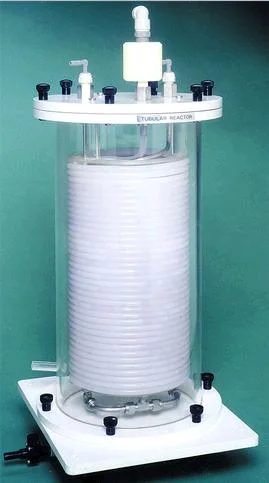
Continuous tubular reaction
Reaction progresses along a defined flow path.
Axial mixing is limited compared with stirred vessels.
Configurations support multiple phase systems.
Glass makes flow distribution and fouling observable.
Salient features
The tube arrangement, mixing internals and heat-transfer surface are selected around kinetics, viscosity, phase and temperature limits.
Hollow-pipe flow provides a direct and scalable continuous reaction path.
Internal elements promote radial mixing for laminar and viscous fluids.
Jacketed and falling-film formats provide high heat-transfer capability.
Small working volumes and effective heat transfer can moderate reaction conditions.
Transparent tubular arrangements can be configured as photo-bioreactors.
Double-pipe, tubular and shell-and-tube configurations are available.
Reactor configurations
Each configuration changes mixing, heat transfer and residence-time behaviour; final selection follows the process parameters.
Straight or multi-pass tubular systems support gas- and liquid-phase chemistry with low axial back-mixing.
Liquid and gas travel through jacketed columns or tube clusters in annular or annular-mist flow, supporting tight temperature control.
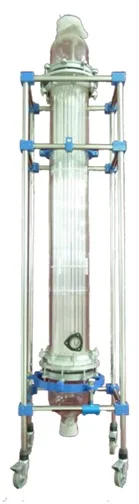
Glass tubular systems can be configured for photo-biological processes such as algae production and other small-scale continuous duties.
Related system
Where complete vessel mixing is more important than plug-flow behaviour, review the glass CSTR configurations.
Discuss your requirements