UD Technologies logo

Falling Film Evaporators

Glass falling-film evaporators for short-contact-time concentration, distillation and solvent recovery of heat-sensitive or corrosive liquids.

UD Technologies · Vadodara, India
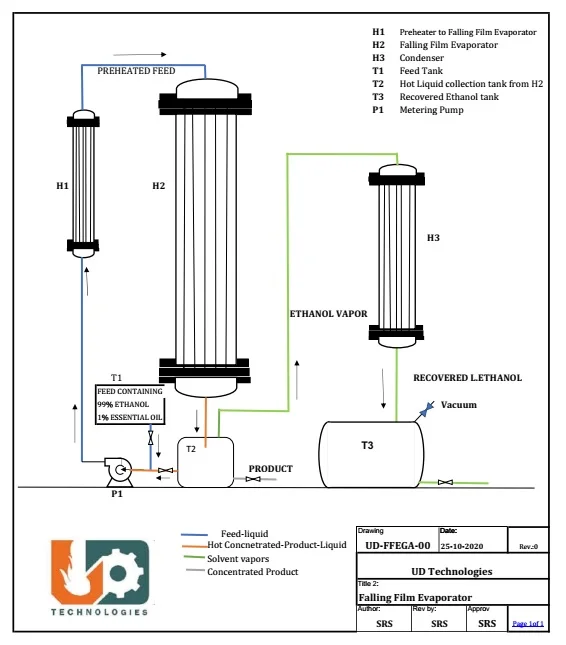
Glass falling-film evaporator

Short-residence evaporation

Concentrate sensitive liquids in a rapidly moving film.

Feed is distributed evenly across the inside of vertical heating tubes and flows downward as a thin film. Heat supplied through the surrounding shell partially evaporates the liquid; concentrate and vapour then enter a separator for independent withdrawal. Low liquid hold-up, small temperature differences and contact times of only a few seconds per pass make falling-film evaporation well suited to heat-sensitive products. Reliable operation depends on complete tube wetting and a distribution system designed for the feed rate, viscosity and operating condition.

2–20 m²

Standard heat-transfer areas with larger sizes on request.

4–12 inch

Available evaporator diameters across pilot and production scales.

Seconds per pass

Short contact time protects heat-sensitive material.

Low hold-up

Fast startup and easier product or cleaning changeover.

Salient features

High heat transfer with low product exposure.

Distribution, wetting, vapour direction and automation are engineered together for stable concentration.

Even liquid distribution

A purpose-designed head wets the tube surface uniformly.

Rapid heat transfer

The thin film supports evaporation with a low temperature difference.

Responsive control

Feed, vacuum, energy input and concentration respond quickly to adjustment.

Visible processing

Glass makes film distribution, boiling and fouling directly observable.

Consistent concentrate

Automatic controls can stabilise product concentration.

Corrosion-resistant construction

Borosilicate glass and PTFE suit aggressive process liquids.

Flow arrangements

Select vapour flow and separation around the duty.

The relative direction of vapour and liquid changes film thickness, heat transfer, stripping and low-temperature performance.

Co-current falling-film evaporation

Liquid and vapour travel downward together

Vapour shear thins the liquid film and can improve heat transfer and stripping before bottom separation.
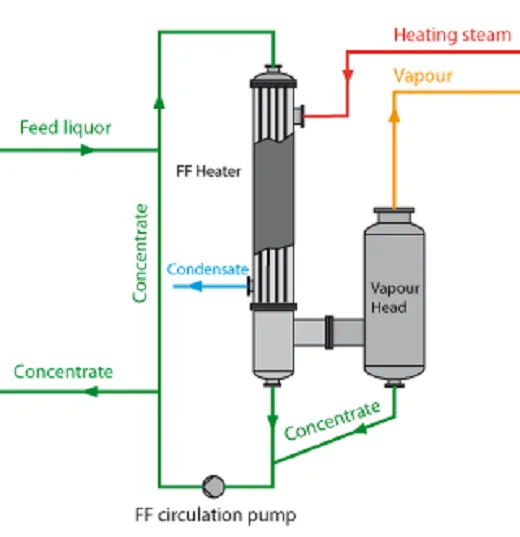
Falling-film evaporator operating principle

Process characteristics

Flow direction
Liquid and vapour downward in parallel
Separation
Concentrate and vapour separate at the bottom
Film effect
Vapour shear can thin the film
Typical benefit
Higher heat-transfer coefficient and effective stripping
Counter-current falling-film evaporation

Vapour rises against the descending liquid film

Counter-current operation can support vacuum evaporation at low temperature or the introduction of inert gas to lower partial pressure.

Process characteristics

Liquid withdrawal
Concentrate removed at the bottom
Vapour withdrawal
Vapour removed at the top
Typical benefit
Low-temperature vacuum or inert-gas-assisted operation
Design caution
Vapour rate must avoid flooding and unstable operation

Related system

Handle more viscous or fouling feeds with active wiping.

A wiped-film evaporator mechanically renews the product film where gravity flow alone is insufficient.

Explore wiped-film evaporators →

Discuss your requirements

Let’s find the right solution.

Contact our team ↗