
Standard · Non-flameproof
For general-purpose installations.
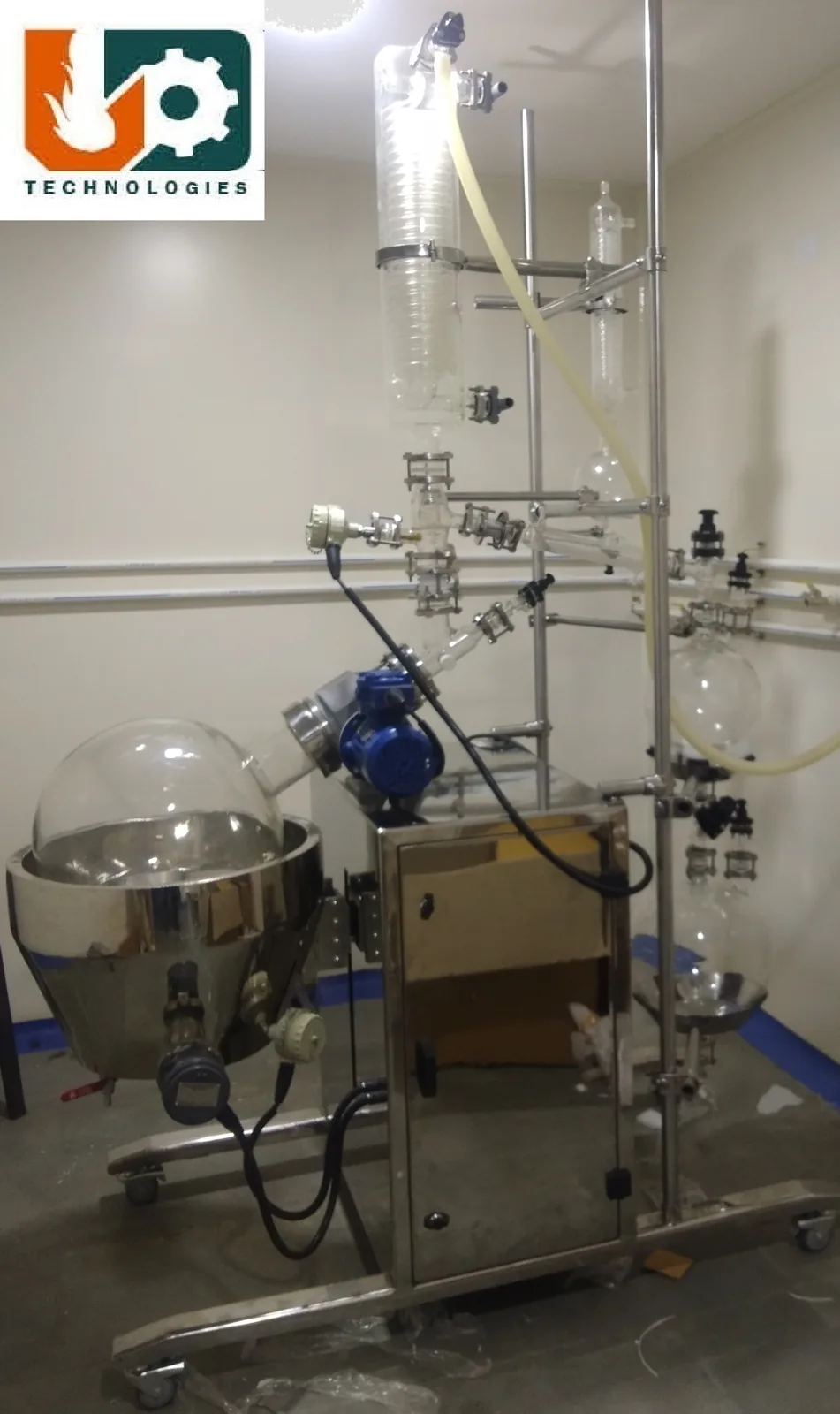
Industrial rotary vacuum evaporation for solvent recovery and gentle concentration of heat-sensitive materials, available from 5 to 100 litres.
UD Technologies · Vadodara, India
Operating principle
For general-purpose installations.
For classified operating areas.
For validation-led production.
Validation and hazardous-area protection.
Salient features
Configurations can be adapted to the feed, process duty, validation requirements and site safety classification.
Compact, mobile models are available in 10, 20, 50 and 100 litre sizes.
The distillation arrangement can be configured for the application and process.
A dry mechanical seal and glass or PTFE contact parts reduce downtime.
A dedicated arrangement supports safer removal of the hot evaporating flask.
Microprocessor-based controls use clear, large digital displays.
Industrial instruments are selected for long service life.
Choose non-flameproof, flameproof or ATEX-compatible configurations.
Standard and GMP models are available with supporting documentation.
Glass arrangements can be adapted around client operating requirements.
Combo models support solid-liquid extraction followed by concentration.
Process guidance
Use the solvent chart to compare boiling points at different vacuum levels and coordinate bath, vapour and coolant temperatures.
Capacity-wise specifications
Open a model to review its construction, controls, safety provisions and process performance.
Designed for solvent removal and concentration of heat-sensitive materials. A rotary extractor variant combines solid-liquid extraction and concentration. For research work, 500 mL, 1 L and 2 L evaporating flasks can also be fitted.
Alternative glass distillation assemblies are available. GMP, flameproof, SS 304 and SS 316 configurations can be supplied.
An industrial configuration with selectable electrical supply, flameproof options and validation documentation.
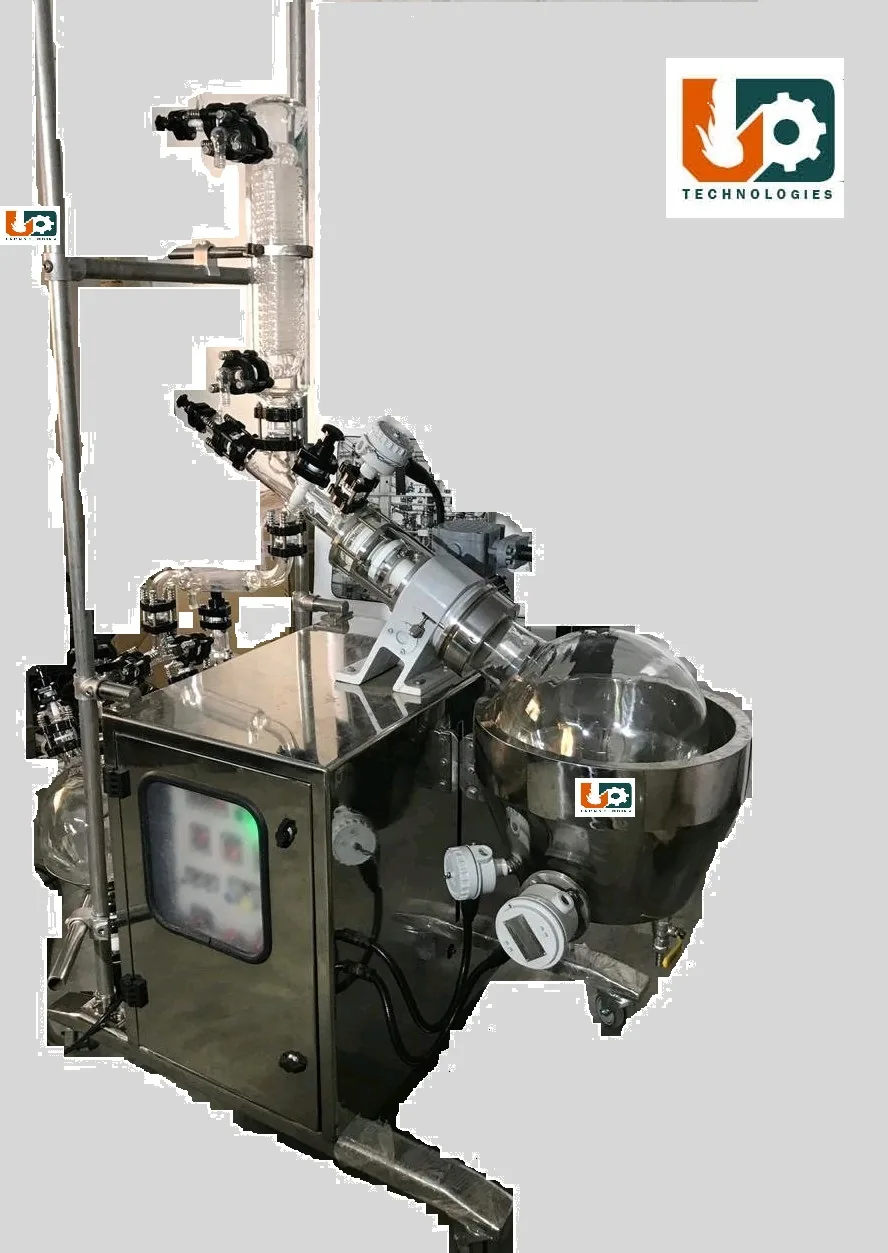
Designed for duties ranging from standard evaporation to complex distillation with vacuum control. At a 40°C bath-to-vapour temperature difference, the system can distil approximately 5.5 L/h water equivalent or 16 L/h acetone.
Discuss your requirements