UD Technologies logo

HCl Gas Generation — Boiling Route

Continuous dry HCl gas generation from 30–33% hydrochloric acid, available from 10 to 300 kg/h with reusable 20% acid bottoms.

UD Technologies · Vadodara, India
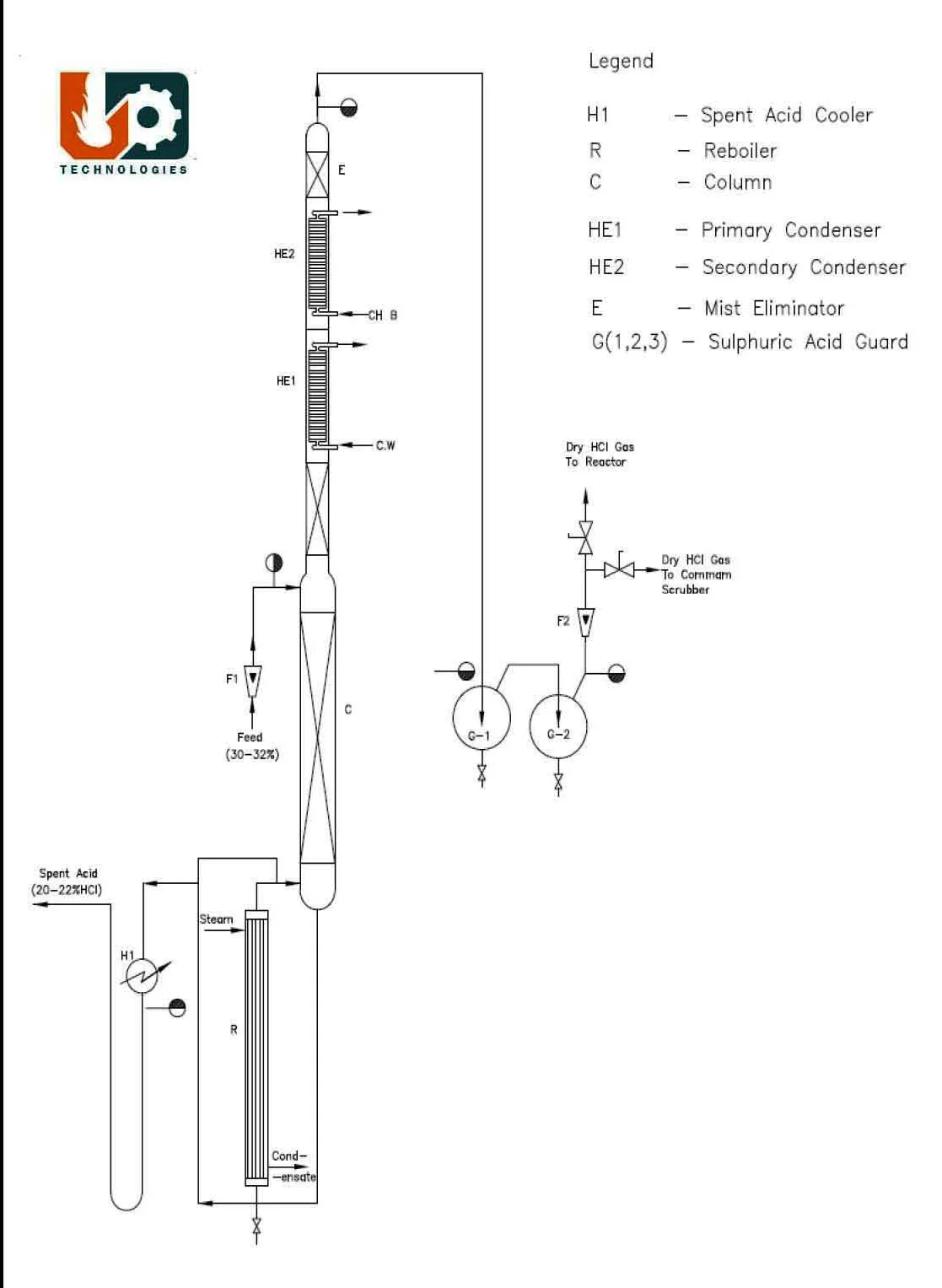
HCl gas generation process by the boiling route

Azeotropic HCl generation

Generate dry HCl continuously from commercial hydrochloric acid.

The boiling route distils 30–33% hydrochloric acid toward its 20–21% maximum-boiling azeotrope. Hydrogen chloride and water vapour leave overhead while approximately 20% acid is withdrawn from the bottom for cooling, storage or reuse. A thermosiphon reboiler supplies heat, and a sequence of cooling-water, chilled-water and brine condensers reduces water carryover. Final drying with a dehydrating agent can deliver gas with very low residual moisture, depending on the drying performance.

10–300 kg/h

A broad dry-HCl production range.

Continuous process

Stable feed, boiling, conditioning and withdrawal.

≤0.01% moisture

Expected gas moisture subject to drying efficacy.

Reusable bottoms

Approximately 20% HCl can return to in-house use.

Salient features

A compact continuous plant with recoverable acid bottoms.

Materials, utilities, controls and equipment arrangement are selected around the feed and required product.

Preheat recovery

Hot bottoms can preheat the incoming 30% acid feed.

Thermosiphon boiling

Steam supplies heat through a shell-and-tube reboiler.

Progressive condensation

Multiple coolant levels remove water vapour stage by stage.

Final gas drying

A dehydrating unit controls product-gas moisture.

Direct reactor delivery

Systems can be designed to feed large GLRs without a compressor.

Corrosion-resistant wetted parts

Glass, PTFE and impervious graphite suit the acid service.

Process configuration

Review the continuous boiling-route sequence.

Final capacity, materials and instrumentation are confirmed against the process data and site utilities.

Boiling-route HCl gas generator

Azeotropic distillation with staged gas conditioning

Indicative process data

Capacity
10–300 kg/h dry HCl gas
Feed acid
30–33% hydrochloric acid
Bottom product
Approximately 20% hydrochloric acid
Heating
Steam-heated thermosiphon reboiler
Cooling
Cooling water, chilled water and brine stages
Construction
Borosilicate glass 3.3, PTFE and impervious graphite

Related system

Compare a low-effluent generation route.

The calcium-chloride route recycles its extraction agent and minimises waste-acid neutralisation.

Explore the calcium-chloride route →

Discuss your requirements

Let’s find the right solution.

Contact our team ↗